Engineering and design
Mechanical engineering put me close to prototypes, production floors, materials, testing, cost, and quality.
It taught me that an idea is only valuable when it can survive contact with the real world.
My Story
My career has moved from mechanical design and physical-product development through product management, product marketing, P&L ownership, commercialization, digital products, and AI-enabled platforms.
The industries and technologies changed, but the central challenge remained consistent: understand what customers value, identify the right opportunity, align the organization, and turn the strategy into a product that can be built, launched, adopted, and improved.
Each stage added another perspective. Engineering taught me how products work. Marketing taught me why customers choose them. Business leadership taught me how value, investment, operations, and profitability connect. Digital products and AI expanded the scale and speed of what is possible.
Curiosity has been the starting point throughout my career. I want to understand how things work, why customers behave as they do, and what might be possible if a problem is viewed differently. That curiosity supports creative problem-solving and a commitment to continuously learning new industries, technologies, and ways of working.
Today, I bring those perspectives together to lead products across the full journey.
Career journey
My path began with the technical fluency of a design engineer, then expanded through product management, product marketing, P&L ownership, digital and AI products, and enterprise team leadership.
Each step added a different view of how products create value. Together, they allow me to connect market intelligence, customer experience, physical and digital development, business operations, commercialization, and execution.
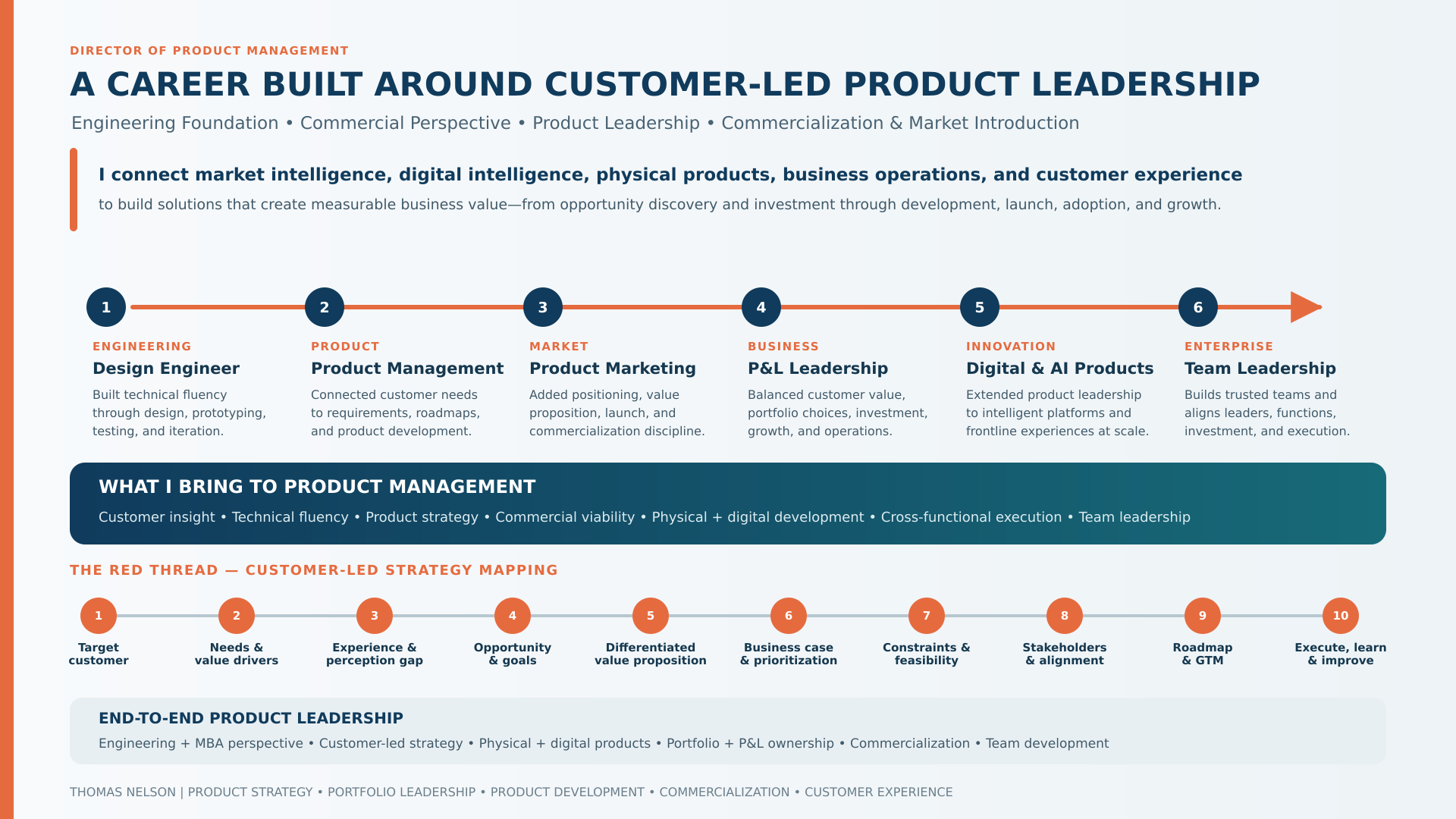
Career progression
Each stage added a different perspective, from understanding how products work to leading the teams and organizations responsible for turning opportunities into results.
Mechanical engineering put me close to prototypes, production floors, materials, testing, cost, and quality.
It taught me that an idea is only valuable when it can survive contact with the real world.
Product management connected customer needs to product requirements, roadmaps, development priorities, and the decisions required to move products forward.
I learned to translate what customers value into products an organization can build and support.
Product marketing added positioning, value propositions, market research, commercialization, and the discipline required to prepare both the company and the market for a launch.
I learned that the best technical answer is not always the answer customers understand or value most.
P&L ownership expanded the question from ‘Can we build it?’ to ‘Can it create sustainable value?’ It required balancing customer value, pricing, investment, operations, growth, and profitability.
I began seeing products as complete business systems, not isolated offerings.
Digital platforms and AI added speed, scale, data, and complexity, but the human questions remained familiar.
Technology creates value only when people understand it, trust it, and use it.
Leading products at enterprise scale requires trusted teams and alignment across leaders, functions, investments, technology, operations, and execution.
My role is to create the clarity, ownership, and environment people need to deliver results and grow.
How I lead
I have led people and teams throughout my career. Today, I lead a team of 10 working across the United States and India. My role is not simply to oversee delivery. It is to create the clarity, trust, and opportunities people need to do their best work and grow into larger responsibilities.
I make sure people understand what we are trying to accomplish, why it matters, how their work contributes, and where they have the authority to make decisions. Regular individual and team conversations create space for honest feedback, early problem-solving, and shared accountability.
I look for opportunities to move team members beyond maintaining existing work and into projects that expand their skills and visibility. Team members have led major digital and AI-enabled implementations, expanded their responsibilities, and earned promotions. I encourage people to ask questions, explore alternatives, test ideas, and treat new responsibilities as opportunities to learn.
Team members have described my leadership as among the most supportive and effective they have experienced. People have requested to join my team, and I am especially proud to have helped individuals expand their responsibilities, develop new capabilities, and earn promotions.
Developing people and delivering results are not competing priorities. Teams perform better when people understand the mission, own meaningful work, and know their manager is invested in their success.